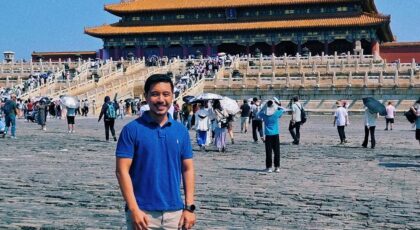

I have only been in Beijing for four months, but already the variety of work is evident. These are still early impressions, but they are shaping how I see my posting in this country.
Currently, I handle both the economic and assistance-to-nationals sections, and earlier I also covered the consular desk. My background in the maritime office in Manila means I still take on work related to the West Philippine Sea. A single day can shift from investment promotion to working on cases involving Filipinos in distress, from clearing visa applications to joining my principals in meetings at the foreign ministry when incidents at sea arise, and to parsing the flow of news between Beijing and Manila. On the busiest days, all of these happen one after another, sometimes all at once.
China, including Hong Kong, is the Philippines’ biggest trading partner and our largest buyer and supplier. Geography and existing circumstances make this trade relationship unavoidable. Much of what we use and consume comes through Chinese supply chains, most visibly in the machines that we use, the appliances and household items in our homes, and the food that reaches Filipino kitchens. Our balance of trade figures strongly suggest that a disruption would not be nearly as difficult on China as much as it would be on the Philippine economy. But this relationship is not only about dependence. Where others see imbalance, I see potential. Filipino jobs are tied to this connection, and there is space for our enterprises to prosper within it. Over the past months, I have joined efforts to promote Philippine tourism, services, and agriculture at trade fairs and investment forums. These events may seem routine, but to me they illustrate how Filipino products, ideas, and talent can find a place in China. At the same time, they show how Chinese investment can thrive in the Philippines, bringing capital, technology, and jobs if directed toward sectors that truly benefit our people.
Economic work often overlaps with the consular side, where numbers and statistics give way to the human face of the service. Last month, I attended a court hearing for a Filipino whose case was resolved in three hours, efficient and fair by most measures in my opinion, though the judgment that followed this month weighed heavily on our kababayan and her family. In Hong Kong and Macau, I saw how centers for overseas Filipinos serve as anchors for communities of hundreds of thousands. In Beijing, the community is smaller, but each case has its own weight. Assistance-to-nationals work has no template. Each problem is different, requiring judgment, empathy, and often diskarte in finding ways with limited means. I am often reminded of the importance of malasakit for kababayan who turn to the Embassy when they have no one else. Admittedly, malasakit does not always come easily to me. I tend to be the kind of person who feels that people should bear the weight of their own mistakes and choices. But in assistance work, I am learning that our kababayan who knock on our doors often carry more than they can handle. It is our obligation to listen with patience and respond with compassion.
Maritime issues are never far from view. They come up in conferences, forums, and dialogues where discussion of the South China Sea is unavoidable. Criticisms of the Philippines are common here in China, and the atmosphere can feel hostile. At one think tank event near the anniversary of the 2016 Arbitral Award, I had to respond to such criticisms. Speaking required careful words, firm but measured, and always under Manila’s clearance. When I stood up, I felt the anxiety of being in a room that felt less like a forum and more like a lion’s den. But silence was not an option. What I said was reported back home and even made the front page of a major broadsheet, a reminder that words spoken in Beijing quickly echo in Manila.
The pace has been steady and at times overwhelming. Some weeks have been filled with trade fairs and meetings, others have been consumed by consular or assistance cases that stretched late into the night. When I do find time to explore, Beijing has felt like an experiential museum. On weekends free of house chores, I have wandered through districts where old factories have been turned into art halls, restaurants, and cafes. There are more malls than I can imagine, alongside plenty of green parks and riverside promenades. I once walked along the Liangma River, which used to be polluted but is now lined with trees and alive with swimmers and kayakers. Each visit to the Great Wall or the Forbidden City serves as a reminder that China thinks in centuries, not decades or election cycles. One evening, I watched ‘Nanjing Photo Studio’ in a Beijing cinema, a film about the Nanjing Massacre. It reminded me that the Philippines and China once endured the same war and both bore the immense weight of loss and suffering. That realization added depth to how I see our ties, shaped not only by present circumstances but also by past experiences.