
There is something particularly bothersome with the condescending arrogance displayed by some people with regard the issue of the urban poor and their problem on housing. Relying on pure legalese, they forward an overly simplified position that since “squatters” do not own the land where their shanties are built on, they deserve to be evicted–by force–using the entire arsenal of the state, to protect the property rights of the owners.
These people fail to recognize the social context of the problem. A fourth of Metro Manila, a staggering 584,425 families according to the National Housing Authority, are informal settlers. When the problem affects a significant portion of the population it ceases from becoming a purely legal problem of property rights and land ownership. It becomes a tragic social phenomenon, in much the same way as peasant landlessness is, and thus calls for fundamental political and economic solutions like agrarian land reform. It is a social phenomenon because it finds its roots in political and economic forces that compel hundreds of thousands of Filipino families to move to urban centers and “squat” on idle lands.
If you think squatters are not entitled to live in their homes, you might as well ask for the eviction of a fourth of Metro Manila for squatting on idle lands. Wow. If you don’t realize it, many of Manila’s laborers come form the urban poor. They do everything from cooking and serving your food, doing your laundry, and ironically–building your homes. You might as well ask for the paralysis of economic activity in the national capital.
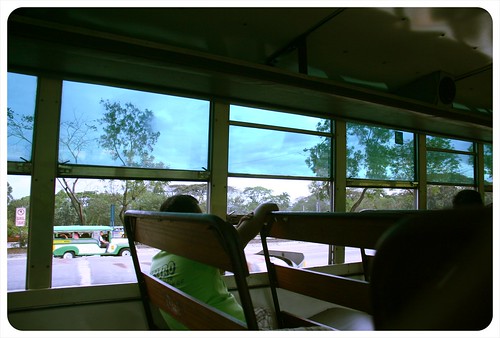
I’ve been taking the ‘ordinary’ bus to school the past three weeks. ‘Ordinary’ buses are what people in Metro Manila call buses that don’t have airconditioning. They have the cheapest fares, and they are most usually the fastest among public utility vehicles (PUV’s).
Yesterday, the bus I was riding to school got ticketed for overspeeding along Commonwealth Avenue, a road known as, aside from being the country’s widest avenue, the killer highway–(it has been declared a ‘traffic discipline’ zone since the beginning of the year precisely because of this). The bus got held up by MMDA traffic enforcers for around fifteen minutes before it got ‘released’. Then it resumed speeding through Quezon Avenue!
Another reason why ordinary buses seem to be the fastest among PUV’s is that they don’t pick up passengers as often as jeepneys nor do they stop as long as jeepneys, FX taxis or air-conditioned buses when picking up passengers. That means when you hail an ordinary bus you have to jog a little in the same direction as the bus in order to grab the railings before hopping in. Sometimes they stop for passengers while in the middle of the road so you have to do some crisscrossing with other vehicles as well.
When all seats are occupied, you have to grab the overhead railings instead and stand on the aisle for the rest of the trip, or until a seat frees up. It feels like hanging on monkey bars at the playground as you sway side to side, back and forward as the bus speeds through the highway.
Since they’re the cheapest, especially on longer routes, ordinary buses are highly patronized by students, construction workers and other minimum (and below-minimum) wage earners.
I appreciate ordinary buses. Whether on provincial trips (I rode ‘ordinary’ buses to Sagada, Zambales, Infanta, Iloilo, Albay), or here in the Metro Manila, I seem to have grown a fascination over them. It doesn’t feel ordinary at all.
For a while now, I’ve been at loss as to what to blog. Scenes of devastation and the actual loss of life and property to millions of Filipinos were overwhelming. It didn’t feel right blogging about anything else where almost everything else will pale in gravity. Guilt perhaps, the very fact that I am able to blog in convenience indicates that, unlike majority of Filipinos who are poor, I am “unaffected.” For a while, blogging in the time of crisis reeked of insensitivity. Some people say blogging and online social media networks played a crucial role in the relief and rescue operations. I agree. But then again, the people who need the relief aren’t online, and prolonged online “involvement” seemed to me like a convenient excuse not to immerse with the people and get dirty with the actual operations. Posting and re-posting relief and rescue operations has to translate into actual relief and rescue operations. Many times, especially during the immediate days after the typhoons, they do, as proven by the thousands who flocked to organized relief operations. With an inept and inutile government, private citizens and civilian organizations needed to fill the vacuum in social services. But for how long? Especially when all those volunteers go back to their schools and to their workplaces?
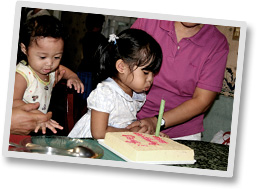
Tisay celebrated her fourth birthday last Monday. We had planned to spend Sunday in a theme park, but since the metro was still reeling from the aftermath of tropical storm Ondoy, we decided to have a simple feast of Chinese food at home.
We had a small sansrival cake for Tisay but we even forgot to buy proper birthday cake candles, so we made do with a medium-sized wax candle. Tisay’s understanding of “birthday” unfortunately, is of a party, so all along up until today she doesn’t believe it was her birthday. She insists that she still has to celebrate her “birthday” distinct from the simple celebration we had last weekend. If the weather permits, we will push through with our trip to the theme park this weekend. I think she even expects to give a blow-out bash to her kindergarten classmates.
Last Wednesday, the sub-committee hearing the budget of state universities and colleges (SUC’s) unanimously committed to restore the budget to its 2009 level. It means to say that the proposed P3 billion budget cut by the President and the Department of Budget & Management is rejected at the sub-committee level, and the budget for the country’s 110 SUC’s would be back to around P24 billion.
Kabataan Rep. Mong Palatino remarked that this is imperative, as the proposed budget has barely any allocation for SUC’s capital outlay. How then can SUC’s affected by the recent calamities rebuild their schools? A few days earlier, the DBM released a statement defending the budget cut in response to several protests launched by the National Union of Students of the Philippines (NUSP).
They claimed that the proposed P21 billion budget is sufficient to sustain the services of SUC’s, as they are anyway allowed to generate their own income. What they didn’t say is that this forced income generating policy is done at the expense of students, through tuition and other fee increases. The statement only proves that our analysis as correct, that budget cuts and tuition increases are state policies that harm the future of the youth and the nation.
For the most part of the university’s existence as a higher institution of learning, policies were crafted and imposed by the Board of Regents (BOR), the highest policy-making body in the university, without the students’ participation.
For the longest time, the BOR had no student representative–the university’s largest constituency long subjected to policies they didn’t see coming. Through sustained and collective efforts of the students, however, which began during the First Quarter Storm, heightened and intensified further during the dark years of Martial Law and beyond, the Office of the Student Regent (OSR) was established.
The OSR serves as the student-run institution where the Student Regent, the sole voting member of the BOR, who comes form the university’s largest sector, is seated. Instituted in 1986, it has served to uphold the interests of the students, voting and arguing on their behalf from issues ranging from appointments of deans to increases in laboratory fees and tuition.
The enactment of RA 9500 or the new UP Charter, however, endangers this institution, under the smokescreen of democratization, by actually subjecting a decade-old Student Regent selection process crafted by duly-elected student council representatives across the UP System and subjected to debates and amendments every year, to a terribly difficult challenge–a challenge that the administration cunningly knows, given the trend of student election turnouts, has the tendency to fail. UP, after all, has more than 55,000 students system-wide.