

I have only been in Beijing for four months, but already the variety of work is evident. These are still early impressions, but they are shaping how I see my posting in this country.
Currently, I handle both the economic and assistance-to-nationals sections, and earlier I also covered the consular desk. My background in the maritime office in Manila means I still take on work related to the West Philippine Sea. A single day can shift from investment promotion to working on cases involving Filipinos in distress, from clearing visa applications to joining my principals in meetings at the foreign ministry when incidents at sea arise, and to parsing the flow of news between Beijing and Manila. On the busiest days, all of these happen one after another, sometimes all at once.
China, including Hong Kong, is the Philippines’ biggest trading partner and our largest buyer and supplier. Geography and existing circumstances make this trade relationship unavoidable. Much of what we use and consume comes through Chinese supply chains, most visibly in the machines that we use, the appliances and household items in our homes, and the food that reaches Filipino kitchens. Our balance of trade figures strongly suggest that a disruption would not be nearly as difficult on China as much as it would be on the Philippine economy. But this relationship is not only about dependence. Where others see imbalance, I see potential. Filipino jobs are tied to this connection, and there is space for our enterprises to prosper within it. Over the past months, I have joined efforts to promote Philippine tourism, services, and agriculture at trade fairs and investment forums. These events may seem routine, but to me they illustrate how Filipino products, ideas, and talent can find a place in China. At the same time, they show how Chinese investment can thrive in the Philippines, bringing capital, technology, and jobs if directed toward sectors that truly benefit our people.
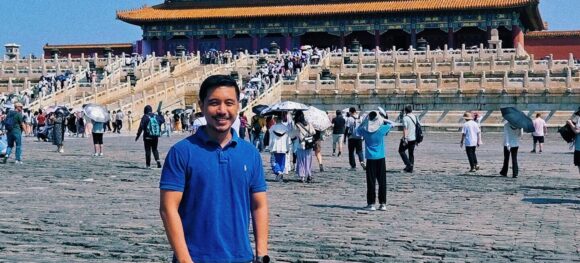
When I landed in Beijing in late May, the first thing that struck me was the heat. Dry, biting, and sharp on the skin. It’s not the heavy humidity of Manila, but a sting that prickles. I had braced for pollution, having been warned about air quality many times before I left. Instead, the skies were surprisingly clear and often cloudless. The avenues were not only long but also deliberately wide. Massive buildings of marble, concrete, and glass stood on both sides, heavy and imposing. They seemed to mirror the strict order and weight of the Chinese capital. Yet amid this hardness were plenty of trees, manicured lawns, and spring flowers, carefully arranged to soften the edges and remind me that even in this immense, unyielding city, appearances are deliberately managed. It was overwhelming, impressive, and impersonal all at once.
The language barrier was just as impermeable. Not being fluent (yet) in Mandarin, every signage and every document felt like a riddle. Even something as simple as figuring out what an establishment was for or deciphering product labels on food and appliances became an exercise in guesswork. Today I still find myself hesitating at shopfronts, unsure whether I am about to walk into a clinic, a massage parlor, or a shop selling something I have absolutely no use for. In the supermarket, I often worry that what I think is soy sauce might turn out to be vinegar or something I should not ingest. It is a constant reminder that adjusting here would take more than diplomatic training, it would demand daily patience and humility of the sort that reduces me to the turo-turo school of acting, pantomiming, and looking a little silly just to communicate simple needs and run errands.